
Urban Design Science for Health
Laboratory on Urban Design Science for Health
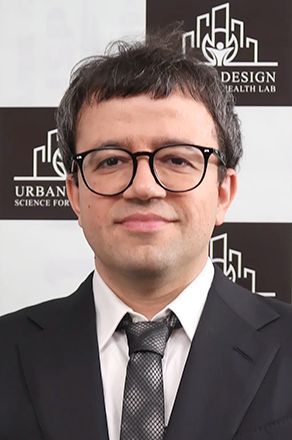
Associate Professor:KOOHSARI Javad
E-mail:
[Research areas]
Urban Design Science; Public Health
[Keywords]
Urban Health; AI in Urban Design; Urban Analytics; Urban Fo
Skills and background we are looking for in prospective students
Students from different disciplines, who have an enthusiasm for conducting ‘interdisciplinary science’, are welcome to join this laboratory. Basic knowledge of statistics and good English written and oral communication skills are required.
What you can expect to learn in this laboratory
Prof Koohsari founded and leads the Urban Design Science for Health Lab. He obtained his PhD in Urban Design and another PhD in Health & Sport Sciences. Prof Koohsari has a publication record with over 140 refereed journal articles (such as in Nature Reviews Cardiology). From 2021 to 2025, he was continuously recognised in the top 2% of most influential researchers worldwide across all scientific disciplines (Stanford University & Elsevier). Students graduating from this laboratory will gain a solid understanding of scientific theories and conduct research on the emerging field of urban design science and health.
【Job category of graduates】 Academic jobs, Consultant companies, Civil servant
Research outline
The Urban Design Science for Health Lab was established in 2022. It promotes urban design as a scientific discipline and focuses on generating rigorous, policy-relevant evidence to improve built environments, particularly in densely populated and rapidly transforming urban contexts. The lab integrates spatial analysis, epidemiological methods, and artificial intelligence (AI) to examine how urban form influences human health and wellbeing, especially in high-density contexts. Many urban areas today face intersecting challenges, including population ageing, increasing prevalence of non-communicable diseases, extreme heat, environmental pressures, and transport congestion. These conditions demand spatial strategies that are grounded in science, supported by data, and adaptable to local governance and planning needs.
The lab’s current thematic areas include:
• AI in urban design for promoting healthy ageing.
• Future directions for AI applications in urban design research.
• Data-driven spatial modelling for evaluating urban environments in relation to health resilience and well-being.
Fig. Urban Design Science for Health Lab
Key publications
Dr Koohsari has a publication record with over 140 refereed journal articles (such as in Nature Reviews Cardiology). Some of his publications are listed here:- Koohsari, M. J., Kaczynski, A. T., Talen, E., & Oka, K. (2025). From Associations to Action: Parametric Urban Design Science for Cardiometabolic Health. Developments in the Built Environment, 100814.
- Koohsari, M. J., & Kaczynski, A. T. (2025). Make cities more walkable, in the real world and in virtual reality. Nature, 646(8083), 38.
- Koohsari, M. J., McCormack, G. R., Nakaya, T., & Oka, K. (2020). Neighbourhood built environment and cardiovascular disease: Knowledge and future directions. Nature Reviews Cardiology. 17(5): 261-263.
Equipment
Statistical software, Geospatial software
Teaching policy
This laboratory supports students to be active participants in their learning process. This will be accomplished by encouraging students to take an active role in deciding upon, learning about, and leading their research ideas and interests, with considerable support and guidance.
[Website] URL : https://urbandesignhealth.org/